

Live Spot Gold
Bid/Ask
4,164.304,166.30
Low/High
4,153.804,218.10
Change
-29.30-0.70%
30daychg
-236.50-5.37%
1yearchg
+188.80+4.75%
Silver Price & PGMs
(Kitco NewsWire, Monday, Oct. 12th, 2026) – The gold market is struggling to maintain its recent recovery as persistent inflation pressures, elevated bond yields and a U.S. dollar trading near an 18-month high continue to create significant headwinds for the precious metal ahead of another critical week of economic data.
Gold prices started the week with modest gains, briefly trading above $4,200 an ounce during the Asian session; however, bullish momentum has faded as investors remain reluctant to take significant positions ahead of Wednesday’s U.S. Consumer Price Index report.
Spot gold was last quoted around $4,156.20 an ounce ahead of the North American trading session, down nearly 1% on the day. The precious metal has been unable to build on last week’s recovery after prices briefly fell below $4,100 an ounce. Despite the recent buying momentum, gold remains well below its August highs as investors continue to assess the implications of tighter monetary policy and stubborn inflation.
Silver is also struggling to maintain its recovery, with prices trading around $60.35 an ounce after briefly pushing above $61 earlier in the session.
The latest U.S. economic data continues to paint a complicated picture for financial markets as weakening consumer confidence contrasts with persistently elevated inflation expectations.
On Friday, the University of Michigan reported that its preliminary consumer sentiment index fell to 46.3 in October, down from 48.1 in September and below expectations of 47.6. The current economic conditions index dropped sharply to 44.7, its lowest reading on record.
At the same time, consumers’ one-year inflation expectations increased to 4.7%, up from 4.6%, while longer-term expectations rose to 3.5% from 3.4%.
The disappointing sentiment data follows September’s weaker-than-expected employment report, which showed that the U.S. economy created only 29,000 jobs, while the unemployment rate increased to 4.2%. Although signs of slowing economic growth would normally support expectations for looser monetary policy, persistent inflation pressures continue to complicate the Federal Reserve’s outlook.
The U.S. dollar remains a significant obstacle for the precious metal, with the U.S. Dollar Index holding near 102.20, close to its highest level in approximately 18 months. (Kitco Global Index shows how much of today’s gold move is the dollar versus the gold market itself.)
Simon-Peter Massabni, Head of Business Development at XS.com, said that the dollar continues to benefit from the combination of persistent energy inflation, geopolitical uncertainty and elevated U.S. Treasury yields.
Massabni added that persistent inflation pressures are preventing central banks from easing monetary policy and forcing fixed-income markets to adjust to expectations for higher interest rates.
Although the dollar’s strength is weighing on gold, analysts note that the precious metal continues to attract safe-haven interest as investors navigate deteriorating economic conditions and growing geopolitical uncertainty.
The ongoing conflict between the United States and Iran remains a significant source of uncertainty, particularly as negotiations to reopen the Strait of Hormuz have failed to produce a lasting resolution. Iranian officials have rejected U.S. proposals as inadequate, while renewed attacks on Saudi Arabian infrastructure and continued military deployments have raised concerns about further regional escalation. Although oil prices have eased following President Donald Trump’s announcement of a proposed energy ceasefire between Russia and Ukraine, the risk of renewed disruptions to Middle Eastern energy supplies remains elevated. Brent crude has retreated toward $105 a barrel, while West Texas Intermediate is trading above $92 a barrel. For gold, the conflict remains a double-edged sword: geopolitical uncertainty supports safe-haven demand, but higher energy prices threaten to keep inflation elevated, reinforcing expectations for tighter monetary policy.
Meanwhile, the U.S. bond market continues to present another significant challenge for gold as the benchmark 10-year Treasury yield remains well above 5%, near levels not seen in almost two decades. Although rising yields increase the opportunity cost of holding non-yielding assets such as gold, analysts note that the reasons behind the bond market’s weakness are becoming increasingly important. With U.S. sovereign debt exceeding $40 trillion and annual interest costs surpassing $1 trillion, investors are demanding greater compensation for the risks associated with holding long-term government debt. Persistent inflation, growing borrowing requirements and concerns about the sustainability of U.S. fiscal policy are contributing to higher term premiums. While these developments create immediate headwinds for gold, they could also reinforce its longer-term appeal as an alternative monetary asset and portfolio diversification tool.
Massabni said that despite the current headwinds, gold is approaching an important technical and fundamental turning point.
“The key question is not simply whether gold can rebound from this area, but whether the underlying economic and fundamental conditions are strong enough to turn a potential recovery into a more sustainable bullish trend,” he said.
He identified the area between $4,155 and $4,177 an ounce as an important support zone, adding that a sustained recovery will depend on whether inflation data allows Treasury yields and the U.S. dollar to lose momentum.
However, he warned that stronger-than-expected inflation could reinforce expectations for additional monetary tightening, potentially exposing gold to renewed selling pressure.
The market’s next major test will come Wednesday with the release of September’s Consumer Price Index. Investors will be watching whether rising energy prices are becoming embedded in broader inflation pressures, particularly core consumer prices.
A softer-than-expected inflation report could ease expectations for further Federal Reserve rate hikes, providing some relief for gold and silver. Conversely, another upside inflation surprise could push bond yields and the dollar higher, increasing the risk of renewed selling pressure across the precious metals complex.
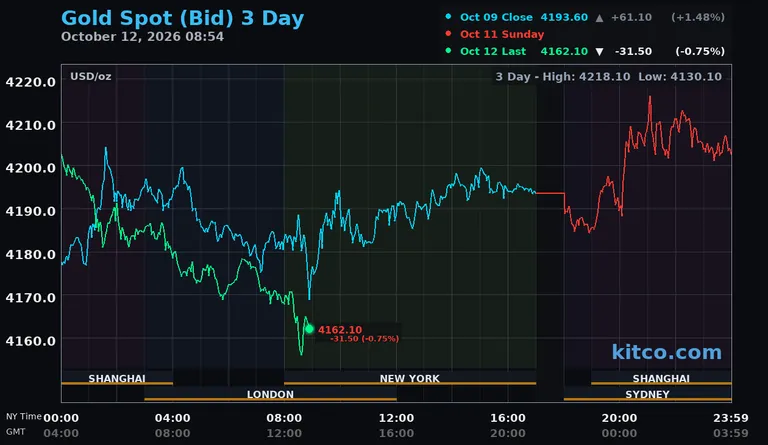
Gold’s near-term outlook remains bearish as prices continue to trade below a descending trendline and longer-term moving averages. Initial support is seen at $4,175.03 an ounce, followed by $4,141.86 and $4,103.24. A break below these levels could expose further downside toward $4,067.42. On the upside, initial resistance is seen at $4,226.82, with a sustained break above that level potentially opening the door to $4,271.57 and $4,311.17. Analysts note that gold will need to overcome its declining trendline to establish a more sustainable bullish recovery.
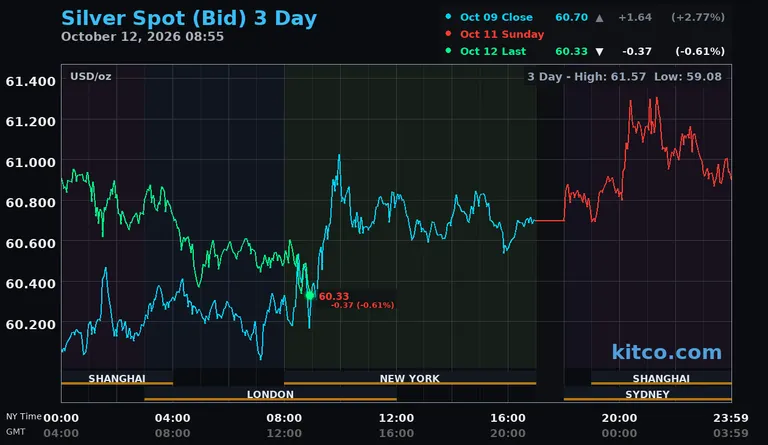
Meanwhile, silver’s technical outlook also remains cautious as the precious metal struggles to overcome resistance from its declining trendline. Analysts are watching initial support at $59.96 an ounce, followed by $58.74 and $57.64. On the upside, initial resistance is seen at $61.72, followed by $63.06 and $65.09. A sustained move above $61.72 would be an important indication of improving bullish momentum, while a break below $59.96 could signal renewed selling pressure.
Although precious metals remain vulnerable to further near-term volatility, underlying investment demand continues to provide some support. Global gold-backed exchange-traded funds attracted approximately $10 billion in September, with holdings rising to a record 4,256 tonnes. Central bank demand also remains elevated, with official-sector purchases projected at approximately 720 tonnes this year.
With U.S. Treasury markets closed Monday for the Columbus Day holiday, trading conditions could remain relatively subdued as investors wait for fresh inflation data and further clarity on the Federal Reserve’s monetary policy outlook.
Posted by:
Jack Dempsey, President
401 Gold Consultants LLC
jdemp2003@ gmail.com