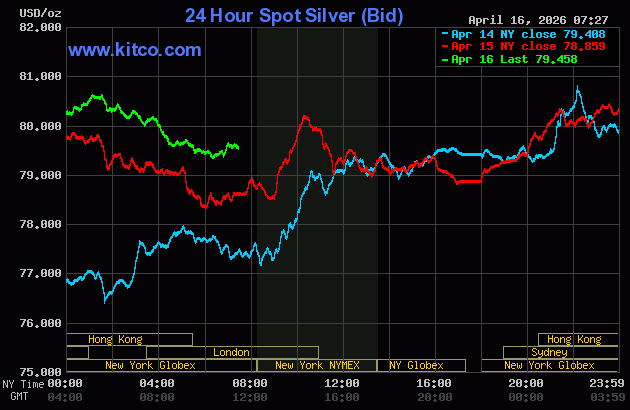
Live Spot Gold
Bid/Ask
4,785.804,787.80
Low/High
4,773.204,839.30
Change
-4.20-0.09%
30daychg
-201.10-4.03%
1yearchg
+1,447.10+43.31%
Silver Price & PGMs
(Kitco News, Thurs. April 16th, 2026) – Gold and silver prices are posting mild gains in early U.S. trading Thursday. Technically related buying from the shorter-term futures traders is featured today, as both metals are in fledgling near-term price uptrends on their daily bar charts. June gold was last up $15.70 at $4,839.30. May silver prices were up $0.212 at $79.81.
Latest on the war in the Middle East…
–Strait of Hormuz shipping traffic remains way down amid blockade
–Bessent ‘optimistic’ gasoline prices will drop to $3 per gallon over summer
–Half-full oil tanker heading to Japan highlights scramble for crude
–Pakistan faces extensive blackouts as gas shortfall worsens
Pakistan has stepped up efforts to ensure the U.S. and Iran prolong a ceasefire that’s set to end next week, allowing more time for the warring sides to negotiate a lasting peace deal. Both countries are considering a two-week ceasefire extension, according to a person familiar with the matter and as reported by Bloomberg. Neither side desires restarting fighting, said another person familiar with the discussions, with the war having devastated Iran’s infrastructure and sent energy prices soaring, including in the U.S. “Still, there are many contentious issues for the countries to resolve, including the reopening the Strait of Hormuz, Iran’s nuclear and missile programs and sanctions relief for the Islamic Republic. For now, Washington and Tehran are saying they haven’t agreed to any ceasefire that lasts beyond late Tuesday U.S. time,” said the report.
Fed’s beige book: war causing business uncertainty. The conflict in the Middle East was cited by the Federal Reserve’s beige book as a major source of uncertainty that has complicated decision-making around hiring, pricing and capital investment, with many firms adopting a wait-and-see posture. Wednesday afternoon’s Fed report said U.S. economic activity continued to increase at a slight-to-modest pace across most regions, despite higher uncertainty, and price growth remained moderate overall, but energy and fuel costs rose sharply in all 12 Fed districts. The U.S. labor market remained stable across most districts, but several districts noted increased demand for temporary or contract workers, as firms remained cautious about committing to permanent hires due to the uncertainty.
Baltic Dry Index rises to four-month high. A key gauge of bulk shipping rates climbed to the highest since early December, driven by a surge in demand and tightening vessel supply. The Baltic Dry Index rose 5.5% to 2,484 points on Wednesday in London, extending its rally for a ninth straight session. The index tracks freight rates across Capesize, Panamax and Supermax vessels hauling raw materials including iron ore, coal and grains. Demand was concentrated in Capesize ships, the segment most exposed to iron ore.
China’s economic growth stronger than expected. China’s economic growth rebounded more than expected in the first quarter, with GDP expanding 5% from a year ago. Industrial output grew 5.7% in March from a year ago, while retail sales increased 1.7%, down from a 2.8% expansion in the first two months. The economy’s growth was driven by strong manufacturing and exports. However, consumer spending and private investment continued to cool, resulting in an increasingly lopsided economy.
Euro zone inflation upticks. Euro-zone inflation was faster than initially reported in March, suggesting stronger upward pressure on prices from the U.S.-Iran war. Last month’s reading was revised up to 2.6%, year-on-year, from an initial estimate of 2.5%, Eurostat said Thursday. The gauges for core and services inflation came in at 2.3% and 3.2%. March marked this year’s first increase in the inflation rate beyond the European Central Bank’s 2% annually target as the fighting in the Middle East drives energy costs higher. The revision followed similar moves this week by France, Italy and Spain.
Note: The gold market operates through two primary pricing mechanisms. The first is the spot market, which quotes prices for on-the-spot purchase and immediate delivery. The second is the futures market, which sets prices for delivery at a future date. Due to year-end positioning market liquidity, the December gold futures contract is currently the most actively traded on the CME.
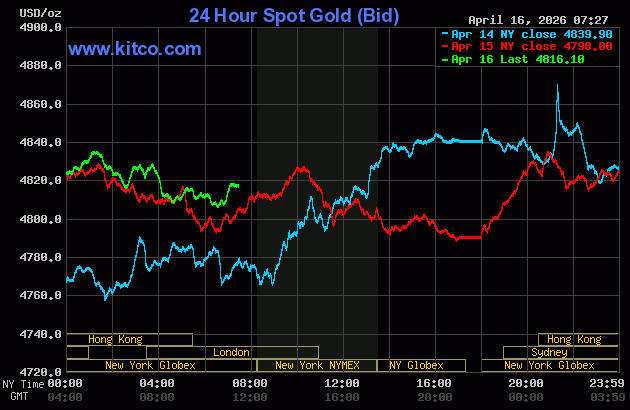
Technically, June gold futures bulls’ next upside price objective is to produce a close above solid resistance at $5,000.00. Bears’ next near-term downside price objective is pushing futures prices below solid technical support at $4,500.00. First resistance is seen at this week’s high of $4,895.40 and then at $4,950.00. First support is seen at $4,800.00 and then at $4,750.00.