

Live Spot Gold
Bid/Ask
4,480.904,482.90
Low/High
4,423.404,515.80
Change
+47.20+1.06%
30daychg
-162.50-3.50%
1yearchg
+1,111.50+32.99%
Silver Price & PGMs
401 G.C. Educational Series , June 2026
SILVER
Silver does not move quietly for long.
When prices start climbing, most headlines fall back on the usual explanations, inflation fears, a weaker dollar, or vague “safe haven demand.” These do not adequately answer the crucial investor question: “Why is silver going up?”
The answer comes from several key forces that do not always make the news.
Industrial demand is surging in ways that didn’t happen ten years ago.
Physical supply remains tight despite steady mining output.
Last but not least, investor behavior is shifting as confidence in monetary policy continues to erode.
In other words, this isn’t just another short-term price spike.
If you’re wondering why silver is going up, the real answer requires looking at both the visible drivers and the structural pressures building behind the scenes. Some are cyclical. Others could shape the market for years.
WHY ARE SILVER PRICES RISING RIGHT NOW? (QUICK ANSWER)
Silver is going up due to rising industrial demand, persistent inflation, limited supply growth, and increasing investor interest. Structural changes in the market are also amplifying price movements.
Why Is Silver Going Up? The Simple Answer
There are a few primary drivers that are causing the price of silver to rise:
- Inflation expectations
- Industrial demand surge
- Investor demand / mining supply discrepancy
Inflation expectations are often an evergreen cause for silver price fluctuations.
Silver remains a monetary metal, famous for its capacity to hedge against inflation. Precious metals like silver demonstrate longstanding trends of retaining value in the face of inflationary pressures or rising interest rates. As the dollar loses its purchasing power, gold, silver, and other precious metals often retain their value or become more valuable.
Industrial demand surging is a relatively new phenomenon, and it has changed the way that silver works in the market. This has had a tremendous impact on both the investor demand and the silver supply production. We’ll explore this further below.
Industrial Demand for Silver Is Surging (And It’s Different This Time)
Many have noted by now that silver is increasingly prominent in the industrial sphere. Increasingly, industrial products like solar panels, EVs, and electronics are driving silver consumption more than monetary investors.
This shift is causing a spike in silver demand, and this trend does not seem likely to reverse any time soon. Silver is irreplaceable in many of these applications because of two incredible traits it possesses:
- High conductivity
- Antibacterial properties
These traits make silver irreplaceable in many technologies. For example, silver’s high conductivity makes it essential in solar panels and smartphones. The reason for that is that it has a very high melting point, but can conduct both heat and electricity at incredible speeds.
That conductivity is what allows these devices to function. And, at least for the foreseeable future, there aren’t many options to replace silver.
What does that mean? Well, previously, silver has operated largely on the basis of cyclical demand. Now, it has undergone a structural change. Rather than following the cycle of monetary investor demand, the silver market is now driven to a large degree by constant industrial demand.
The other facet that is often overlooked is that the industrial demand might not remain stable. In fact, it may grow due to government policy.
Green energy policies across varying states often make technology like solar panels more widely used. Solar panels require silver to function. As a result, silver goes into higher demand and becomes more heavily consumed.
Why Supply Isn’t Keeping Up With Demand
There are several reasons the silver supply is not matching the demand. We’ll explore a few of those here.
Silver Mining Production
Another factor driving silver prices upward is the slow pace of production. As industrial and monetary investors continue to buy silver, the quantity they take out of circulation does not get replaced.
One leading reason for this is mine production constraints. First, it must be noted that silver is generally a byproduct of other metal mining operations. It is rarely the focus of a mining company.
What that means is that when silver goes into high demand, many mines do not even attempt to increase production to meet that demand. They are not willing to divert their attention away from their intended metals to prioritize silver instead.
On top of this, silver mining is an international industry. Geopolitical tensions and conflicts can hinder silver mines from getting their product to market as sanctions, embargos, heightened taxes, and other policies target their country of operation.
Declining Ore Grades and Rising Costs
Another issue is that the silver ore that isbeing produced is of reduced quality. High-grade silver ore deposits have depleted in number; as a result, lower-quality ore has seen increased processing.
Additionally, operating costs have risen, and the timeline for producing silver has become incredibly extensive. New, high-quality silver therefore takes significantly longer to enter the market.
Silver Recycling Limitations
One way that the silver market has managed to keep track with the demand for silver is through recycling silver. Indeed, some silver items are easily recycled. That’s especially true of sterling silver.
However, higher purity silver is much harder to recycle. It is more expensive to recover this silver. Beyond that, there are technical challenges in separating complex industrial components, and, at times, economic infeasibility. Those technical challenges can also make silver economically wasteful.
Physical Market Tightness vs Paper Supply
Something else that many people don’t discuss is the way silver shortages impact the physical vs paper silver markets. In the physical market, shortages manifest themselves in the form of high premiums and low inventory. This is because it becomes harder to source bullion during these shortages.
The paper market works a little differently. In the paper market, silver shortages show increased, highly volatile speculative trading. This trading does not have as much of an impact on the silver price itself, though it is a factor in how the spot price is determined.
Inflation and Currency Weakness Still Matter
Inflation remains one of the most persistent forces behind rising silver prices. As the purchasing power of the US dollar declines, hard assets like silver tend to attract renewed interest. Investors are not just chasing price momentum: they are responding to a long-term erosion in currency value that shows up in everyday costs.
Real interest rates play a critical role here. When inflation runs higher than nominal yields, holding cash or bonds guarantees a loss in real terms. That environment historically benefits precious metals.
Silver often lags gold early in the cycle, but can move more aggressively once investor demand accelerates.
There’s also a psychological component. Confidence in central banks and monetary policy has weakened after years of aggressive money creation and rising debt levels. When trust fades, tangible assets gain appeal.
In short, inflation and currency weakness do not act alone. Rather, they set the foundation. Even when other drivers take the spotlight, these underlying pressures continue to support prices and help explain why rallies tend to have staying power rather than fading quickly.
Investor Demand Is Picking Up Again
Investor demand is starting to re-enter the silver market, and it often does so in waves.
Retail buyers are usually first. When economic uncertainty rises or headlines turn negative, demand for physical silver coins and bars tends to increase. This shows up in higher premiums and tighter availability before it’s fully reflected in spot prices. It’s a signal that small investors are positioning early, not reacting late.
Institutional money typically follows. ETF inflows and managed fund positioning can amplify price moves once momentum builds. These players are less concerned with owning metal itself and more focused on exposure. When they rotate into silver, price gains can accelerate quickly.
There’s also a shift in sentiment cycles. Silver tends to move from a “fear trade” to a “momentum trade.” Early buyers are motivated by protection. Later participants are drawn in by rising prices and the potential for outsized returns compared to gold.
This pattern matters because it suggests the current move may still be in its earlier stages. When both retail and institutional demand align, silver doesn’t just drift higher, it can move sharply in a short period of time.
The Paper Market vs Physical Silver: Why the Price Doesn’t Always Reflect Reality
Most silver pricing doesn’t come from buying and selling real metal. It comes from the paper market, primarily COMEX futures contracts.
These contracts represent large volumes of silver traded on leverage, often with no intention of physical delivery. In practice, this means the “price of silver” is largely determined by financial positioning rather than direct supply and demand for bullion.
This creates a disconnect.
In the physical market, supply can be tight. Dealers may report low inventories, rising premiums, or delayed shipments. Yet at the same time, futures prices can remain flat or even decline. That’s because price discovery happens in a paper-driven system where contracts can be created in far greater quantities than actual metal exists.
This also explains why shortages don’t immediately translate into higher prices. As long as futures markets remain liquid and traders are willing to sell contracts, the spot price can stay suppressed despite real-world constraints.
The adjustment often comes later, sometimes suddenly, when physical demand forces a repricing or when confidence in paper claims weakens.
For investors, this distinction matters. The paper market sets the price, but the physical market reveals the stress. When the gap between the two widens, it often signals that underlying conditions are more bullish than the headline price suggests.
Is Silver Still Undervalued?
Silver is not as undervalued in the market as it has been previously. As of March 22, 2026, the gold-to-silver ratio was approximately 66:1. However, there have been times when silver was of much greater value. This chart shows how silver remains undervalued when compared to past peaks, despite recent price gains.
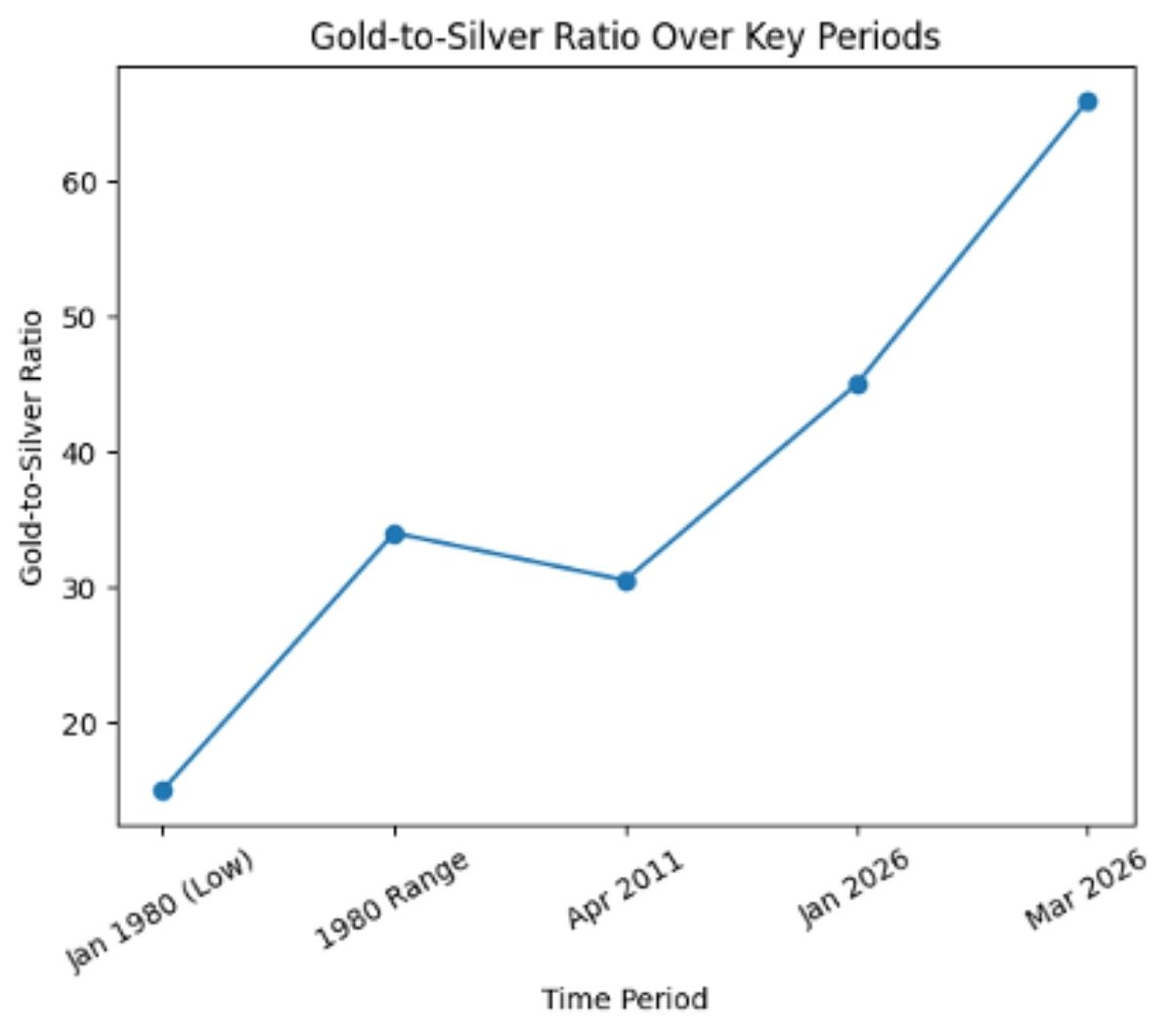
In January 1980, the gold-to-silver ratio reached a low range of 14:1 and 16:1. However, estimates for the full year are significantly higher. Ranges fall between 29:1 and 39:1. The incredible low from January of that year was driven by the Hunt brothers, who attempted to corner the silver market. Their efforts helped push silver to $50 per ounce, while gold leveled at $850 per ounce.
Another great low was in April 2011, when the gold-to-silver ratio hit approximately 30:1 to 31:1. Similarly, in January 2026, when gold and silver hit record heights of $5,500 and $121 respectively, the ratio was roughly 45:1.
When compared with the January 2026 cycle, the ratio has significantly shifted, and silver is not as highly valued as it was. This is not uncommon when silver hits a bubble, as seen in 1980.
However, that does not mean that the ratio cannot narrow again. There are reasons to believe that silver will go up once again, which we will cover in the next section.
Will Silver Keep Going Up? Key Factors to Watch
It is possible that silver will continue to go up. Investors who want to analyze the silver price and its momentum would do well to monitor these factors:
- Interest rates / Fed policy
- Industrial demand trends
- Supply disruptions
- Investor sentiment
The first thing to keep in mind are interest rates and Fed policy, as these have a direct impact on the value of the dollar. The devaluation of the dollar drives up the prices of gold and silver.
Industrial demand trends are also a critical factor to monitor. If current trends continue, silver will continue to be a valuable commodity.
However, there is also a possibility that some of the trends could reverse. The lack of silver in the market may cause industries to find alternative materials to replace silver in their components.
Even if that happens, though, silver supply disruptions can continue to boost demand. When that occurs, it causes the silver price to rise.
One of the biggest factors, though, will be investor sentiment. If investors want silver, that means there is demand. Where there is demand, there is value.
In contrast, if investors are not interested in silver, it does not matter if the supply is abundant or scarce. The lack of demand will drive prices downward.
Why Is Silver Going Up? Frequently Asked Questions
Q: Why is silver going up right now?
Silver is rising due to a combination of strong industrial demand, persistent inflation, limited supply growth, and increasing investor interest. These factors are creating both short-term price momentum and long-term upward pressure.
Q: Will silver prices keep going up in 2026?
Silver prices could continue rising if key drivers remain in place, including high demand from green energy sectors, ongoing inflation, and supply constraints. However, prices may remain volatile depending on interest rates and larger economic conditions.
Q: Is silver a good investment during inflation?
Silver has historically performed well during periods of inflation because it helps preserve purchasing power. While it can be more volatile than gold, it often benefits from both monetary demand and industrial use.
Final Thoughts: What This Means
When investors ask, “Why is silver going up?” they are rarely interested solely in the market factors. What they really want to know is, “is silver a good investment?”
When you consider that, it is important to distinguish between short-term volatility and long-term opportunity. Silver can have a very volatile market in the short term. However, over a longer timeframe, silver consistently retains its value and helps hedge against the devaluation of the dollar.
To really secure those benefits, physical silver is often the preferred investment over and against paper exposure. Paper silver is heavily affected by the stock market, as well as counterparty risk. In contrast, physical silver has no counterparty risk and a low correlation to the stock market.
In short, the thing that matters for silver is a positioning mindset. Don’t just listen to hype surrounding the market. Instead, it is important to focus on preparedness down the line.
Posted by :
Jack Dempsey, President
401 Gold Consultants LLC
jdemp2003@gmail.com